—Rebecca Cunningham
An Effective Costume
An effective costume engages the audience's attention and enhances the production and the performance. However, the characteristics of an effective costume vary with the venue. Clever costume details that would be appreciated in an intimate setting, such as a private party or small restaurant, may miscarry in the typical venue for a dance troupe, where the performers are set apart from the audience on a stage or stage area. When a solo performance is on a stage, scale back on details and dial up the impact by making the costume strong and easy to read at a distance. When a group is on stage, the costumes must also be easy to read at a distance but must also be harmonious with each other."Nearly every costume in the group has some variation within the theme. Often, each dancer is differently costumed. However, if this is so, there will always be a unifying factor throughout, be it shape, colour, period, national detail or ornament. When the costumes vary very considerably, the dressmaker must make sure that whatever factor or detail is uniform in all the group, it is exactly uniform, as this forms the essential 'tying together' detail."— Mary Kent Harrison
- Do not sabotage the dance with the costumes. Make the costumes complement your artistic message.
- Control what the audience is paying attention to by making all parts serve the whole.
- The human mind is hard-wired to pay attention to the exception. Noticing exceptions was the key to survival! Unfortunately, this mechanism doesn't turn off just because the audience is watching your dancing instead of scanning the forest for lions. Eliminate the costume inconsistencies that generate visual exception reports and distract attention from the dancing.
Group dances are especially problematic because every extra person on stage increases the possibility of sending a contradictory message if you haven't analyzed WHAT the message is and how you will reinforce it with the costuming!
Arabesque Dance Company of Canada sets a standard for "simple" Raqs Sharqui costumes that blend on stage into a lavish and delightful whole. Beautiful fabric, lush colors, simple shapes, and a bit of glitter and glam create harmonious impact!
Jawaahir Dance Company specializes in Middle Eastern folk dances. Their costuming follows the same principles as Arabesque Dance company does: Beautiful fabric, simple shapes, and a bit of jack-daw shiny. The result? Real impact on stage.
A beautifully pared-down professional presentation by Carolena and Fat Chance Belly Dance. The common design elements and bold touches of color tie the group together with minimum cost and effort. Any weakness or hesitation by less-skilled dancers will be mitigated by the harmony of the costuming.
Mary Kent Harrison, How to Dress Dancers: Costuming Techniques for Dance, 1975, Midas Books.
Read My Hips has done a good job of American Tribal group costuming for more than a decade, counting on consistency and simplicity to make an impact on stage.
An Effective Message
Before planning the costuming, define your reason for being on stage. This can as simple as: American Tribal group wants to perform together on stage. Or it can be a complex story or theme, with several sub-themes in action at the same time. Once you know your reason or story, then drill down to details.- Time: Era, season, special date. War, feast, famine.
- Location and Culture: another country, another time, another planet, or even purely imaginary.
- Sub-Group: Rich/poor; Parent/child; Farmers/ nomads; Entertainers / customers
- Individual Dancer Role:
- Personality, including age, gender, rank and social status
- Protagonist/ Antagonist?
- Leads /Supports?
- Protagonist/ Antagonist?
- Movement Support:
- Fast / slow
- Smooth / twisting
- Level / Leaps and bounds
- Earthy / airy
- Flowing / syncopated
- Small / large
- Serpentine / energetic
- Smooth / twisting
Deliver The Message
Stage costumes must project OUT to the audience. The audience must be able to "read" them at a distance.- Line and Silhouette; the outline of the costume will be as (or more) important as the costume itself if the venue is any bigger than a restaurant.
- Proportion: Costume pieces and parts should be in pleasing proportion on the dancer's body. Uneven divisions of space are more pleasing than equal or extremely unequal divisions. Do not use equal or extremely unequal divisions unless a jarring or unnerving effect is desired.
- Color: black costumes are easier to assemble but often disappear on stage.
- Scale; Delicate details may help the dancer get into role but the audience needs large visual clues.
- Texture and structural texture: use this to stay on message.
- If the venue is a stage, make sure that you use colors that can be seen clearly and are attractive together at a distance.
- Anticipate the lighting and scenery challenges. If an understanding of the backdrop and lighting can be obtained ahead of time, choose costumes and accessories that are harmonious with those colors and conditions.
- Plain red light turns colors with any blue in them (including purple and green) into gray and black.
- Plain blue light turns colors with red in them (red, orange) into brown and black.
- Beware the disco lighting! The constant color changes will make your dancing look choppy, and some of the colors will not be compatible with your costuming.
- Keeping the group costuming harmonious within the group is a strong remedy for less than optimum lighting or backdrops.
- Individual dancers should not wear an all-red or all-gold costume unless
- Other people on stage are also dressed in those colors - or -
- You are a soloist or lead dancer who will be manifesting some of the characteristics of that color.
A: Depends. Notice the difference between Sharon Kihara's back tattoos and the ones on her arms. Which ones can be read at a distance?
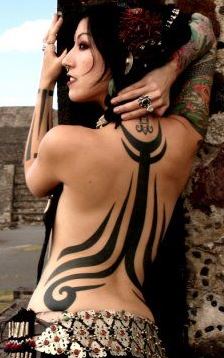
Red is a color associated with courage, danger, energy, passion, defiance and aggression. "It has been demonstrated that a person driving an automobile in traffic will feel a much stronger urge to pass a red car than a blue car, whatever make, model or size the car might be."
Yellow is the first color that the human eye notices. The right yellow denotes confidence, extraversion, emotional strength, creativity. It is a symbol of the deity in many religions. But pure yellow can irritate, lower self-esteem, provoke fear and anxiety.
Ornamentation and jewelry should enhance the desired message, silhouette, color blocking or motion. Tribal dancers often use too much; other dancers too little.
Take Care of Your Dancers
Your dancers cannot do their best if 'something' about the costume is distracting themThe costume should flatter the individual dancer as well as the group.. within reason. Do not leave one or two dancers feeling and looking like beached whales.
- Strive for a design that all can wear. Do NOT use one-size-fits-all pieces unless they truly fit all sizes.
- Do not pretend that there will be no fitting issues unless the entire group is model-size. Identify and plan for them.
- Know the difference between a Halloween costume and a dance costume. Halloween costumes are one pretty layer that will not hold up to movement or cleaning. Dance costumes have a pretty layer on the OUTSIDE, but the lining, underlining and yokes that support the garment are the real costume!
- Have a plan for holding the garment(s) on their bodies securely that does NOT involve dozens of safety pins.
"Although it is for the designer to create the atmosphere of the costumes, both as the group and individuals, it is the costumier's task to see that the designs are adapted to each dancers's needs so that each one appears to perfection, both in his or her own right and as part of the group... Nothing looks worse than a set ofmass-produced costumes which barely, if ever, fit any member of the cast. Each must be made separately, with careful perfectoin for every individual dancer, as if it were intended for the main soloist. Only then does the group look really well-costumed."— Mary Kent Harrison
A dance costume must be able to be danced in.
- Synthetic fibers are cool in winter and warm in summer. Tight costumes of synthetic fabric on an outdoor stage in summer are going to leave the dancers in agony. Natural fibers (silk, rayon, cotton, linen) are warm in winter, cool in summer.
- Minimize audience exception reports. Dancers must be able to raise arms, bend over, bend back, jump, turn and twirl without the costume slipping down, ripping under the arms or wrapping itself around the neck.
- Plan ahead on how it will be cleaned. Will someone really have time to remove all the bling before washing it; can you really afford to send it to the dry cleaners after a gig?
- Plan ahead on how the costume will be altered when necessary.
- Dancing is a sport. The costume must be durable and repairable. A gig is not the same as a Halloween party.
"The costumes have to read as well from the balcony as from the first three rows, so detail and texture or color must balance dubtlety with projection. THey must flatter the lead performers. Although entertainers, especially dancers, provide the best foundation a costume designer could ask for, even their bodies are not perfect... A short-waisted torso must look long, wide hips must be minimized, narrow shoulders must become broad...Most important, the performers must be comforable as the sign, strethc, spin, slide, bend, breathe and sweat. And they must be able to change costumes in seconds... all this must be built into the design." —Joanne Mattera, Costuming for the Stage, Threads Magazine.
Dancers Have Responsibilities,Too
Do not trigger exception reports in the audience mind. Here's what each individual DANCER can do to assist.- If your bra is not fully re-constructed, make sure ALL original parts (straps, hardware, sides, back hooks) are completely hidden from view under a vest or shrug. Audience eyes go directly to anything that looks like underwear, and will often linger there.
- When dancing on stage in a flared skirt, cover legs with pants or leggings. The sudden sight of bare legs will disconcert the audience as much as a bra malfunction.
- Check costume elastics and your bra hardware BEFORE your performance and in time to fix if necessary.
- Minimize / eliminate the use of safety pins by analyzing what you use the pins for and figure out if they can be replaced by alterations.
- If your costume is designed to display your leg(s), wear trunks or bike shorts, not thongs, under your skirt.
- Never pin your skirt to your underwear. If your skirt unhooks and falls down, you will not be bare-bottomed!
- Keep your costume clean and in good repair. You never know when you will have an unanticipated close up.
Please do not get upset if a costume shape is not the most flattering choice for YOU. Yes, a certain kind of neck or bra style might suit you better... or the costume might be more flattering on the younger dancers ... but perfection is a consideration for your SOLO costume. Ditto for the amount of ornamentation or bling. On stage in a group, less is usually more; a simpler presentation contributes to the audience perception of synchronization and power.
Do not make looking thin on stage your ultimate goal. Make a healthy, toned look your goal. Wear a body stocking if you do not want to sport a bare tummy.. MANY dancers use body stockings (skin tone or colored) to feel less 'exposed' or to dress more conservatively when performing.
- Understand, develop and stay in character;
- Contribute to the overall theme and mood of the dance as intended by the choreographer;
- Reinforce the effect of the music.