BabaYagaMusic.com
» Encyclopedic Dictionary
» Many-Colored-Land
» Costume Index
»
[ Keep up with new discoveries with a free subscription to the Baba Yaga Newsletter. ]
Making Yokes and Waistbands for Costumes adds Fit, Strength and Style

Photo credit J Hendrix
Yokes on Costumes solve construction problems.
Yokes add Fit by allowing you to use elastic or ties to hold pants and skirts on your body comfortably when your weight changes. They allow you to add length to skirts and pants that are too short. They allow you to reduce the bulk of a very full garment at the waist and hips.
Yokes add Strength with their duo and tri-ply nature; a yoke on the top of a very full or heavy garment will resist distortion and ripping from the weight of the garment.
Yokes add Style: generic costume pieces such as pants and skirts take on pizzazz with a decorated yoke.
In the picture at the right, the pant yoke is providing a casing for elastic; reducing bulk at the waist of these very full pants; and providing a place for ornamental braid on the costumes of the soloists in the middle.
So what IS a yoke?
A yoke is a rectangular piece of material that is folded and attached to the edge of a costume piece with the intention of supplying fit, strength and /or style.
- A waistband or casing for elastic is a narrow yoke.
- A wider (4 - 6 inch) casing at hip of skirt or pants is a yoke that supports the weight of the attached costume, minimizes the bulk at the waist, and also functions as a casing for elastic or ties.
Circular and Rectangular Yokes
Types of yokes used in these pages:
- Circular: Complete circle, no openings: typically used for casings for skirts, pants and tops.
- The long side is the circumference of the opening (measure with a tape measure).
- The short side is the desired width of the yoke x 2, plus an inch for seam allowances.
- Rectangular: Two openings, with both ends of the casing finished: often used for panel belts and simple tops because this allows elastic or ties to pass through both ends.
Think ahead: if you have enough fabric to cut a second yoke piece, then save it; the yoke will sometimes wear out before the rest of the garment, especially if it is used as a casing for elastic. You will be able to repair / replace the yoke without searching for a matching fabric.
A Circular Yoke: Waistband for Elastic
Cut a waistband 5 inches wide and the circumference of your waist-opening pattern plus 1 inches. Make it too long rather than too short. Ripping a 5" wide piece from selvage to selvage is the fastest way to do this. Or mark with a long ruler and cut. Or make yourself a pattern that is 5 inches wide, with a length equal to the circumference of your waist-opening pattern plus a couple of inches. If your hip is wider than the fabric is wide, rip or cut two 5" wide pieces and connect them.
- Using a tape measure, measure around the waist opening at the stay-stitching line.
- Add one inch to this measurement to determine the length of your waistband.
- Cut your waistband and sew it into a circle using a 1/2" seam allowance.
- Center the waistband seam at the skirt back and pin the waistband to the waist opening.
- Sew waistband to skirt with 1/2" seam allowance.
- Iron the waistband flat and topstitch the top edge.
- Open up the waistband back seam on the inside and run some 1" (or wider) no-roll elastic through it.
- Stitch the elastic ends together or secure the ends of the elastic with a safety pin.
Rectangular Yoke: Hip section for a Panel
This yoke has a finished opening at both ends to allow a tie or elastic to be threaded through. It is frequently used to make panels. The yoke is a bit wider than the panel on both sides to reduce bulk and fraying.
- Calculate width as (2 x desired finished depth of the yoke) plus 1“ for seam allowances plus 1“ to accomodate gathering and turn-of-cloth.
- Calculate length: 2“ longer than the finished width of the panel it will be attached to.
- In short, if you want to add a 3-inch deep hip panel to the top of a panel that is 15 inches wide:
- The width is (3 x 2) + 1 + 1 or 8 inches.
- The length is 15 + 2 or 17 inches.
- Make a 1/4“ hem at both short ends by turning twice and stitching.
- Press a 1/2“ seam allowance along one long side.
- Pin garment piece to unpressed long end, centering the panel on the yoke... you will have an extra 1/3“ on each end of the yoke.
- Stitch garment piece to yoke.
- Press.
- Fold the long side with the pressed seam allowance over the seam you just stitched.
- Pin and sew.
- Topstitch the bottom and, if desired, the top of the yoke.
- Thread tie or elastic through the open-ended yoke.
|
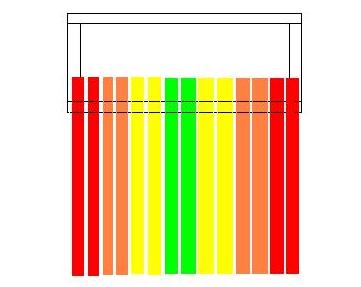
The yoke at Step 5, before being folded over and stitched down.
|
Maintenance
After each wearing, inspect for fraying or holes. Repair or replace yoke as needed. If you saved a second yoke piece when you created the first, you will be able to replace the yoke without searching for matching fabric.
BabaYagaMusic.com
Maura Enright, Proprietor
Author: Maura Enright
©2013 by Maura Enright
© means the content is copyrighted. Your links to this content are much appreciated.
maura@babayagamusic.com